Our Podiatry Services

Our team is composed of highly skilled and experienced podiatrists, holding at least a Bachelor’s degree in Podiatry and possessing advanced qualifications. Our professionals are fully insured, holding both professional indemnity and public liability coverage, are registered with the Australian Health Practitioner Regulation Agency (APHRA), and hold a current membership with the Australian Podiatry Association (APodA).

We adhere to rigorous safety and sterilisation standards (AS/NZS 4187: 2014 and AS/NZS 4815 – 2006) for your well-being.

We understand that each client is unique. That’s why we craft personalised treatment plans that cater specifically to the individual needs of our clients.

Our comprehensive podiatry care includes expert disease management, bespoke orthotic solutions, and a full range of skin and toenail treatments.

But beyond our technical expertise, we pride ourselves on our empathetic approach to care. At Outback Care, we’re not just treating feet, we’re caring for people.

Plantar Fasciitis

The plantar fascia is a band along the bottom of your foot that connects your heel to your toes and supports your arch. If it gets stretched too much or used too heavily, you might get tiny tears in it that can cause swelling and hurt.
Often, this pain hits the hardest first thing in the morning or after you've been sitting for a while. It can feel like a sharp poke or a deep ache, but usually, it gets a bit better after you walk around.
heel pain

Heel Pain

Your heel connects to the Achilles tendon, which links your calf muscles to your foot. Heel discomfort often comes from doing too much, stretching too far, or wearing shoes that don't fit well. Heel pain has several possible sources - it could be plantar fasciitis, a heel spur, inflammation of the bursa, Severs disease, or inflammation of the Achilles tendon. Sometimes, pain from other parts of your body can also feel like it's in your heel.

Blisters

Blisters are frequent issues with feet, but with careful attention, they can often be avoided. They happen when there's too much rubbing on the foot, causing the skin to rip just below the surface. The body then sends fluid to this area to form a bubble-like blister. The blister acts as a cushion, protecting deeper layers of skin from damage and keeping out infections.

Calluses and Corn

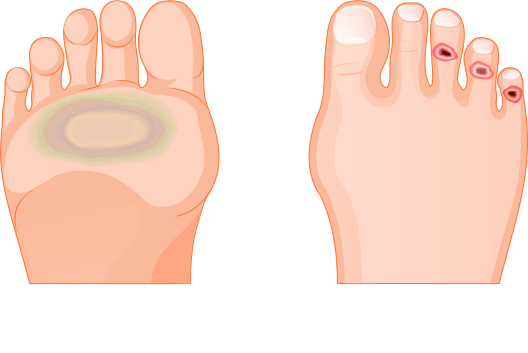
Calluses develop from repeated pressure that causes the skin to thicken, typically appearing on the underside of the feet like the balls or heels. They usually aren't painful. Corns, however, are concentrated areas of hardened skin with a tough core and can be surrounded by sore skin; they often cause discomfort.

Ingrown Toenails

Ingrown toenails happen when the nail's edges curve and dig into the skin next to it. This can make the area swell up and inflamed, and if it's not taken care of, it might get infected.
They often come back, especially on the big toe, but there are steps you can take to stop them from returning.

thick toenails

Thick, discoloured toenails are usually caused by fungus but can also come from injury, getting older, psoriasis, or an infection around the nail. Fungal infections often make toenails curl up, thicken, and turn yellow. It's best to tackle this issue quickly because if you wait, it can lead to more pain and become tougher to treat.

Paying and Claiming

We use a mobile EFTPOS and MMEx (web-based e-Health platform) to produce and invoice receipt on the spot. Credit and debit cards are accepted. Our services are claimable through private health funds, you simply lodge a claim through your private health insurer online or in person.